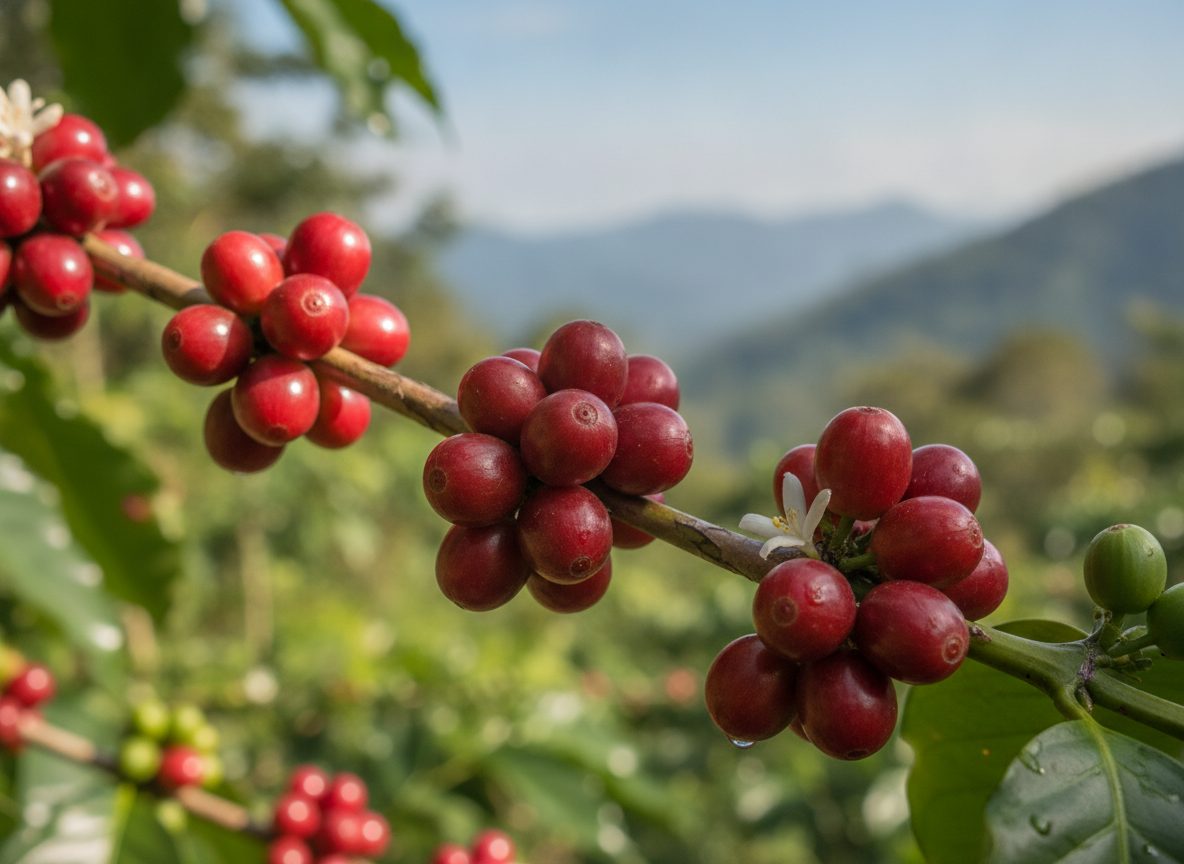
A History Written in Coffee Cherries, From Colony to Cup
The story of coffee in Papua New Guinea is the story of colonialism, geography, and chronic undervaluation. Coffee was brought to what was then the Territory of New Guinea in the late 19th century, planted by European colonists who saw the highland soil and thought: this is coffee country. They were right. They just didn't imagine the world would spend the next century ignoring it.
The first credible records of coffee cultivation appear in an 1890 colonial government report from British New Guinea. By 1897, twenty thousand Arabica plants had taken root on the Variarata plantation near what is now Port Moresby. By 1901, that coffee was being exported to Australia, fetching between 4 and 10 pence per pound.
The colonial geometry matters: German colonists controlled the north, British the south. Both planted coffee to sell to the same market, Australia. That fundamental trade relationship, PNG to Australia, has persisted for 125 years. What has not persisted is any meaningful recognition of where the coffee comes from.
The pivotal moment came in the 1920s when seeds from Jamaica's Blue Mountain region, one of the most prized coffee terroirs on earth, were introduced to PNG's highlands, commercially establishing the Typica variety that still forms the backbone of PNG production today. Commercial output grew steadily from independence in 1975, stabilising around 1.12 million bags by the mid-2000s before entering a prolonged structural decline.
By 2020, PNG was producing roughly 41,000 tonnes, half the 83,000 tonnes recorded in 2000. The causes are structural: ageing trees, coffee berry borer infestations, poor post-harvest handling infrastructure, and the chronic difficulty of moving product from remote highland farms to export ports. All solvable. None solved.
First colonial records of coffee cultivation in British New Guinea, near Port Moresby. German colonists planting separately in the north.
Exports to Australia begin from Variarata plantation, 4 to 10 pence per pound. The Australia trade route is established from day one.
Blue Mountain Typica introduced from Jamaica. Large European and Australian-owned estates dominate. Highland smallholders begin entering production.
Australia's coffee culture transforms: Italian and Greek immigrants bring espresso machines. Melbourne and Sydney café scenes emerge. Demand begins building.
PNG independence. Coffee industry stabilises around 650,000 bags. Smallholder farmers become the backbone, eventually accounting for 85% of production.
The Flat White appears on Sydney café menus, reportedly first listed by Alan Preston at Moors Espresso Bar. Australia begins exporting its own coffee culture to the world.
PNG coffee peaks at 83,000 tonnes. Australia's specialty coffee wave accelerates: independent cafés, single-origin focus, quality over volume. PNG beans flowing in, unrecognised.
Australia's big roasters, Campos, Five Senses, Pablo & Rusty's, Toby's Estate, build national brands. PNG is a supply source, not a marketing story.
PNG production hits a decade low of 733,831 bags. Coffee berry borer, tree age, infrastructure failures. The following year bounces back sharply to 1.13 million bags.
PNG coffee earns $156M USD in export revenue, representing 13% of agricultural export earnings. Still virtually invisible to Australian retail consumers.
PNG exports 963,074 bags. Australia receives ~16% of exports. Global coffee prices surge, PNG farmers see improved returns but post-harvest and logistics remain limiting factors.
PNG coffee has been arriving in Australian ports for over 120 years. It goes into blends, private-label supermarket bags, and wholesale supply for some of Australia's best-known café chains, and almost none of it carries PNG on the label. Instead: Toby's Estate. Campos. Five Senses. The brand is the roaster. The origin is invisible. This is not unique to PNG, but it is particularly galling given the proximity, the history, and the quality sitting in those highland farms.
The Science, Why PNG Coffee Is Genuinely Special
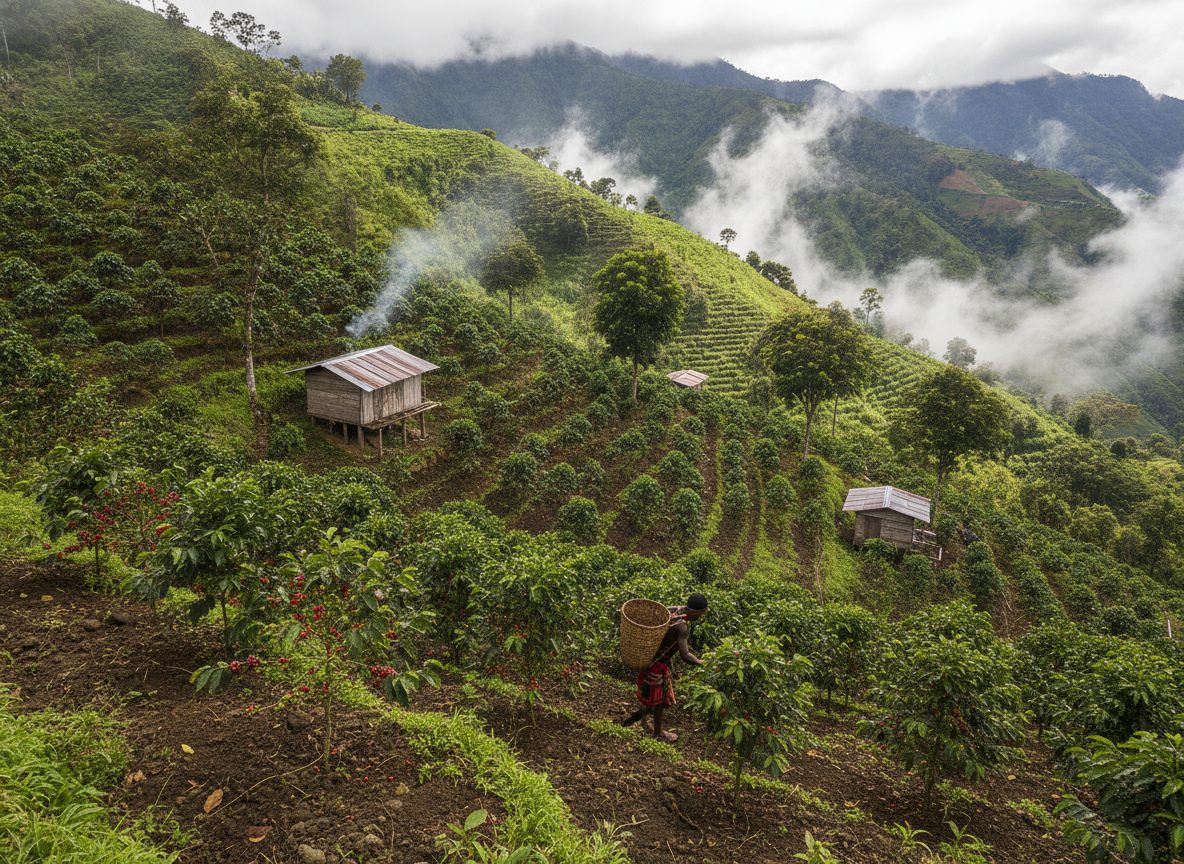
Papua New Guinea's highland geography is, objectively, some of the finest coffee terroir on the planet. The majority of PNG's commercial Arabica is grown at altitudes between 1,300 and 2,000 metres above sea level, comparable to Ethiopia and Colombia, both regarded as the world's gold-standard coffee origins. Fertile volcanic soil, high rainfall, and consistent mild temperatures create the conditions for slow cherry development, which concentrates sugars and flavour compounds.
The terroir of Eastern Highlands, particularly around Goroka and Kainantu, where farms push above 2,100 metres, produces cups that specialty buyers consistently rate in the 85–88 SCA point range. At those scores, this is genuinely competitive with the world's most valued origins. Organic A/X Arabica from Western Highlands has fetched up to $15 per pound at market, one of the highest prices globally for the grade.
The genetics matter too. PNG's Arabica crop is predominantly Typica and its direct descendants, among the oldest, least-hybridised coffee genetics in commercial production. Unlike the heavily modified F1 hybrids increasingly planted elsewhere for disease resistance and yield, PNG's highland trees carry a flavour lineage that traces directly to the original Yemeni-Ethiopian Arabica. That genetic clarity produces a cup that specialty roasters describe as having "heavy body, savory-sweet complexity, and earthy chocolate depth", distinctly different from the bright acidic profiles of East Africa or the clean, sweet notes of Central America.
The risk to this genetic heritage is real. Coffee berry borer (Hypothenemus hampei) is a growing threat, and ageing trees, many over 40 years old and past peak productivity, are a structural problem across the highlands.
"The terroir of PNG is often compared to that of Ethiopia and Colombia. Yet its relative isolation has kept its beans somewhat under the radar, not because the quality isn't there, but because the story hasn't been told."
Specialty Coffee analysis, specialtycoffee.idThe Principal Varieties
PNG's Unique Grading Matrix
PNG uses one of the most rigorous grading systems in the world, assessing screen size, bean shape, defect count, colour, aroma, and cup quality simultaneously. The grades directly determine which markets receive which coffee:
Highest quality, bought primarily by USA (57%) and specialty Australian roasters. Best cup scores, minimal defects.
Australia imports over 19% of PSC grade. Good quality, consistent, the backbone of Australian café supply chains.
Germany ships most Y1 grade (55%). Used primarily in blends across European markets.
Australia receives ~43% of Y3 grade. Ends up in supermarket blends and private label product.
New Caledonia picks up most PNG Robusta (78%). Grown in lowland coastal areas, distinct from highland Arabica.
Australia receives a mixed portfolio, from premium A/X specialty lots (which do get sold as single-origin "PNG" by the better specialty roasters) down to Y3 commercial grade that goes straight into supermarket blends with no origin labelling. The tragedy is that the same country producing world-class A/X coffee is also sending low-grade commodity beans into the same Australian market, and consumers can't tell the difference because neither is labelled "Papua New Guinea."
The Numbers, Australia's Coffee Import Landscape
Australia is now one of the world's most sophisticated coffee-consuming nations, importing over AUD $1.3 billion worth of coffee in 2024. Domestic consumption reached 2.1 million 60-kg bags in the 2024 financial year, with per-capita consumption at 3.84 kg per person annually, comparable to established European coffee markets.
Source: Statista / USDA FAS. Pre-2017 figures estimated from trend data.
Source: Statista / Observatory of Economic Complexity. PNG figure estimated from CIC export data (16% stated market share) and COMTRADE bilateral data. Estimated
*2021 World Bank WITS data for green coffee (HS 090111). 2025 figure includes all coffee, tea, spices (COMTRADE). Pre-2021 estimates based on CIC PNG 16% market share applied to total exports. Estimated
| Origin | Role in AUS market | Share (est.) | Type | Trend |
|---|---|---|---|---|
| 🇧🇷 Brazil | Dominant green bean supplier, blends backbone | 25% | Arabica & Robusta | ↑ Stable |
| 🇨🇴 Colombia | Premium single-origin, specialty cafés | 14% | Arabica | ↑ Growing |
| 🇵🇬 Papua New Guinea | 3rd-largest green bean source; invisible on labels | ~16% | Arabica (95%) | ↑ Increasing |
| 🇪🇹 Ethiopia | Specialty wave darling, single-origin premium | ~11% | Arabica | ↑ Growing |
| 🇻🇳 Vietnam | Commercial Robusta, supermarket blends | ~10% | Robusta | ↓ Stable |
| 🇮🇩 Indonesia | Commercial, some specialty Sulawesi/Sumatra | ~8% | Mixed | → Flat |
| 🇨🇭 Switzerland | Processed/roasted re-export (Nestlé, Nespresso) | 50%+ (roasted) | Roasted | → Stable |
Note: Switzerland dominance in roasted bean imports reflects Nestlé and capsule product supply chains. Green bean (specialty/café) market is entirely different, PNG is the #3 supplier in that segment.
"Australia imports over 1.3 billion AUD worth of coffee annually. Brazil and Colombia are the key source markets in terms of public awareness. But PNG, sitting 3 hours away by air, supplies an estimated 16% of the market and barely registers in consumer consciousness."
Compiled from COMTRADE, CIC PNG, Statista · 2025
PNG Production, The Long Decline and What's Driving It
Papua New Guinea's coffee production has followed a troubling trajectory since 2000. At its peak, PNG produced over 83,000 metric tonnes (approximately 1.38 million 60-kg bags). By 2020, that figure had roughly halved to 41,000 tonnes, a structural decline driven by a combination of factors that specialists describe as entirely preventable.
The Coffee Industry Corporation (CIC), the statutory body regulating PNG's coffee sector, has tracked a 2% average annual production decline between 2006 and 2016, punctuated by extreme volatility. 2015 saw production crash to 733,831 bags (44,030 tonnes); 2016 bounced back to 1.13 million bags. This year-to-year instability makes long-term investment in infrastructure almost impossible.
The structural causes are well-documented: over 85% of production comes from smallholder farmers managing plots of 1–2 hectares. Most of these trees are over 40 years old, well past their peak productive life, and have received inadequate fertilisation and maintenance. Coffee berry borer infestation is widespread. And the logistics of moving product from remote highlands to the port at Lae are genuinely difficult and expensive.
Despite all of this, approximately 2.5 million people, close to half of PNG's entire population, depend on the coffee industry for income. It is the country's most important smallholder crop. In 2021, it generated $156M USD in export earnings, representing 13% of agricultural export revenues and 1.4% of total export revenues.
Sources: FAO via EU Joint Research Centre, CIC PNG. 2023 figure estimated from export bag count (963,074 bags). Data gap 2022–2024
Sources: World Bank, Tridge, ICO. 2024 spike driven by drought concerns in Brazil. June 2026 futures near lowest since November 2024 at ~$2.70/lb ($5.95/kg).
Germany typically buys over 36% of PNG's total annual coffee exports, primarily Y1 commercial grade for blending. The United States takes 25% and focuses heavily on premium A/X grade, 57% of all A/X leaves for the US. Australia takes approximately 16%, receiving a mixture of PSC (19% of all PSC exports go to Australia) and Y3 commercial grade (43% of all Y3). Japan takes 5%, Belgium 5%. These six markets absorb over 90% of all PNG's annual exports. The domestic PNG specialty market is less than 2% of production.
The Brand Erasure, Why PNG Doesn't Exist on Australian Café Menus
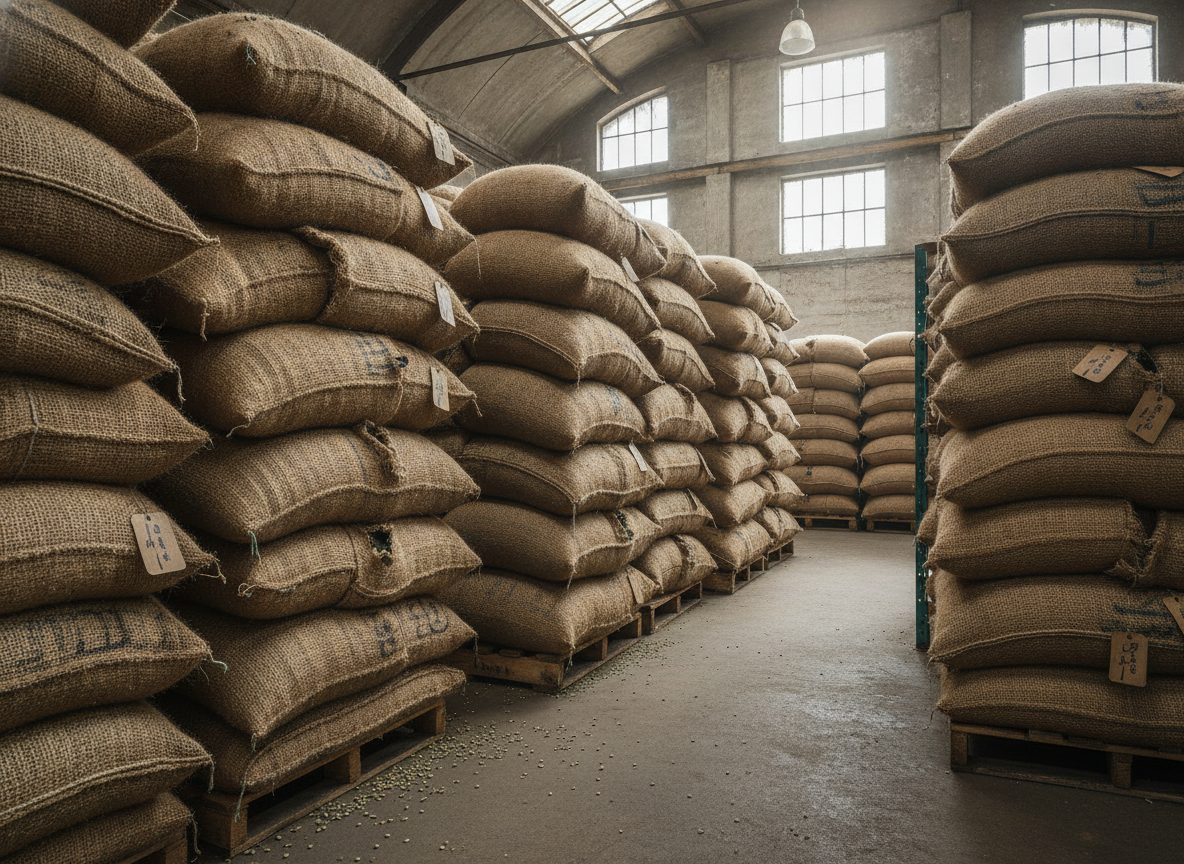
Here is the central paradox of PNG coffee in Australia: it is one of the largest sources of the beans going into Australian café cups, and it is almost entirely invisible on the labels, menus, and marketing of the country's most prominent roasters. When you order a coffee from Campos, Toby's Estate, Five Senses, or any number of premium Australian roasters, there's a reasonable chance PNG Arabica is in your cup. You will almost certainly never be told that.
This is a systemic feature of how the Australian specialty coffee market evolved, not a conspiracy. The business model of the major Australian roasters is built around the roaster brand, not the origin. "Campos" means something. "Toby's Estate" means something. "Papua New Guinea PSC Grade" means nothing to most consumers. So it goes into the blend, the house espresso, the wholesale supply to the café down the street, and the country label disappears.
The irony runs deep when you examine what PNG is actually sending. Pablo & Rusty's, one of the more ethically conscious of Australia's major specialty roasters, first Australian coffee roaster to achieve B Corp certification, made a point of visiting PNG highlands in 2023 and blogging about it: "Having spent a week in the highlands, seeing the effort and care taken with coffee, I have great respect and admiration for PNG coffee and the people who produce it." They are proud to source from PNG. But even among progressive roasters, PNG tends to be a seasonal single-origin offering rather than a permanent menu fixture.
The PNG Coffee Australia organisation has recently started running exporter showcases for Australian industry professionals, an acknowledgement that even within the trade, PNG's identity as an origin is undercooked. The problem isn't quality. It's the pipeline between farm and label.
When PNG coffee is sold as single-origin "Papua New Guinea" by Australian specialty roasters, it commands a genuine specialty premium, comparable to Ethiopian or Colombian offerings. When it goes into blends unlabelled, it's priced as commodity-grade green bean. The financial gap between these two fates is enormous. PNG farmers growing A/X quality coffee that ends up in a supermarket blend receive commodity pricing. PNG farmers whose coffee is traceable, certified, and sold with the origin story receive 2–3× more per kilogram. The brand erasure isn't just a cultural problem. It's a poverty trap.
The Roasters, Australia's Major Players
Environmental & Social Reality, The Full Picture
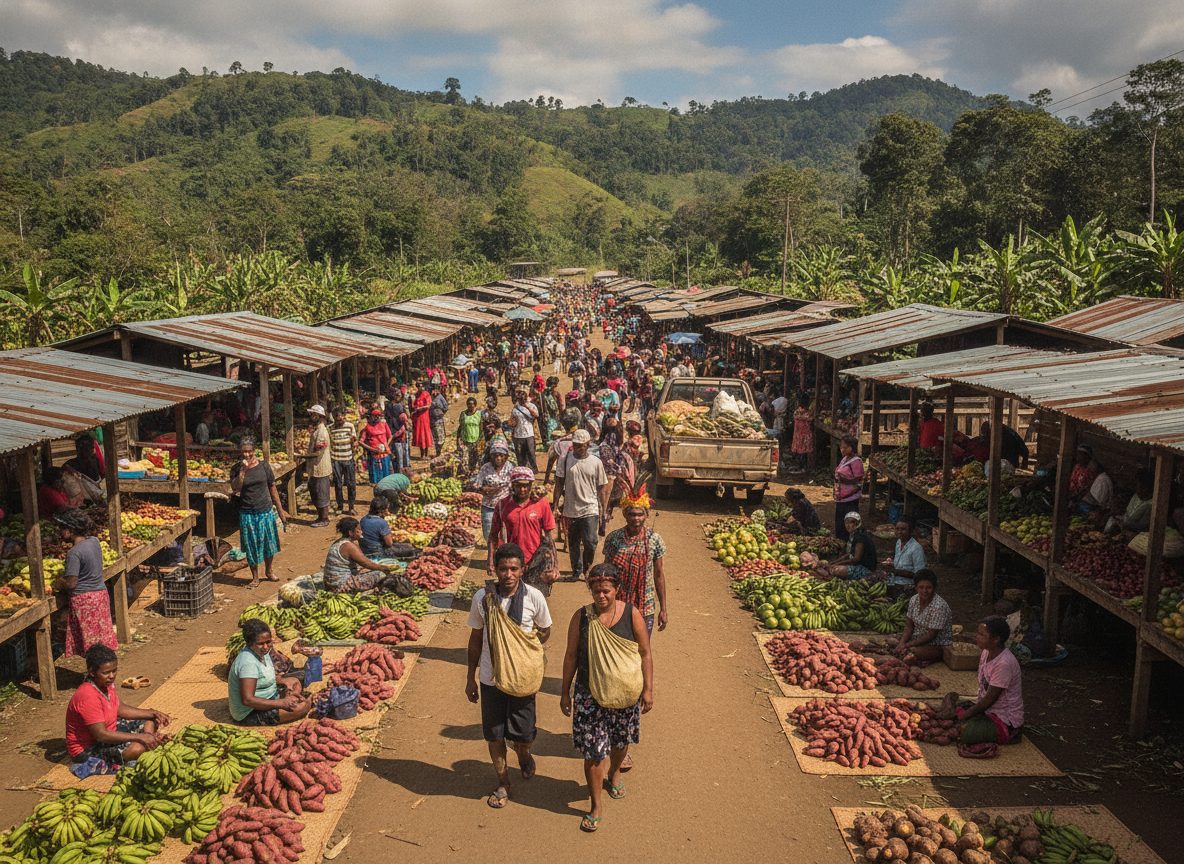
The majority of PNG's smallholder coffee is effectively organic by default, not certified, but grown without synthetic fertilisers or pesticides due to limited access and cost. Many farms exist within or adjacent to forest systems. This is a genuine environmental advantage that specialty buyers can market as "low-intervention."
PNG retains over 63% forest cover nationally, one of the highest in the Asia-Pacific. Coffee smallholdings are typically intercropped with other food species and shade trees. PNG coffee does not drive significant deforestation in the way palm oil does in other highland areas.
PNG's proximity to Australia means sea freight is the primary logistics pathway, a fraction of the carbon cost of air-freighting Kenyan or Ethiopian coffee. For Australian consumers concerned about supply chain emissions, PNG is the logical choice. The Port Moresby to Sydney sea freight distance is under 3,000 km.
2.5 million people, roughly 40% of PNG's population, depend directly on coffee income. Choosing PNG-origin coffee has a direct, traceable social impact on highland communities. Premium pricing through certified or single-origin channels can meaningfully change household income.
Coffee berry borer (Hypothenemus hampei) infestation is widespread across PNG's highlands and represents the most immediate biological threat to production quality and volume. A simulated 10% productivity shock from CBB could cut export earnings by tens of millions of dollars. Control requires coordinated agronomic intervention that smallholders often can't afford alone.
Highland PNG's ideal growing conditions are altitude-dependent. Climate modelling suggests rising temperatures will push optimal growing zones higher, a process that compresses viable farmland. Extended dry seasons linked to El Niño events have already caused significant production disruptions in PNG's highlands.
PNG's road network in the highlands is genuinely poor. Moving coffee from farm to the port at Lae or Port Moresby can take days, adds cost, and creates post-harvest handling problems (moisture, fermentation) that damage quality. This infrastructure gap is the single biggest preventable cause of PNG's grade distribution skewing toward commercial rather than specialty.
Wet processing, the standard method for PNG's washed coffees, is water-intensive. While PNG has plentiful rainfall, improper effluent management from wet mills can contaminate local waterways. This is a quality-infrastructure problem: better-resourced wet mills recycle water; subsistence-level operations often don't have that capacity.
Goroka and Kainantu regions above 2,100m. Volcanic soil, consistent rainfall. Produces the best PNG specialty lots. Coffee berry borer pressure exists but manageable at altitude. The quality is here, the infrastructure to unlock it isn't always.
Mt Hagen region. Organic A/X from here has fetched $15/lb, world-class pricing. Cultural richness and rugged terrain. Road access is the limiting factor for consistency. One of the highest-potential but most underinvested regions in PNG coffee.
PNG's smallest province but most densely populated. 1,600+ masl, ideal soils. Bright acidity and floral notes. The density of smallholders here makes logistics coordination especially challenging, cooperative models are most effective.
Outlook, Can PNG Coffee Get the Recognition It Deserves?
The structural conditions for PNG coffee's recognition are improving, slowly. Global coffee prices hit multi-decade highs in 2024, Arabica spot prices exceeded $8/kg, which improved PNG farmer returns and created financial headroom for investment in tree replanting and processing infrastructure. As prices moderate in 2025–26, the window narrows but doesn't close.
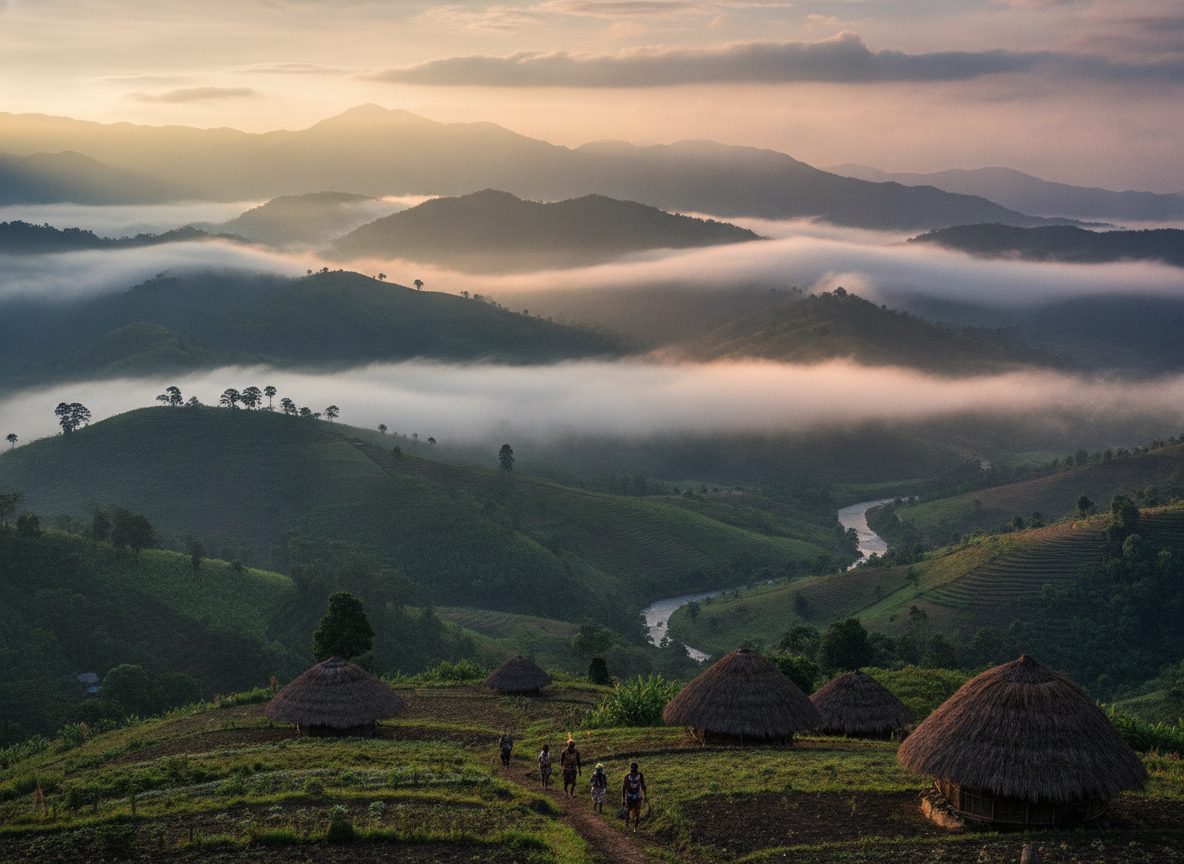
The specialty coffee movement globally is now actively looking for "new" origins, origins with genuine terroir stories, sustainable practices, and direct-trade relationships. PNG ticks every box: ancient Typica genetics, volcanic highland terroir, smallholder-dominated, proximity to a sophisticated consumer market. The story is there. It hasn't been told at volume.
The PNG Coffee Australia organisation's industry events, bringing Australian roasters face-to-face with PNG exporters, are a sign that origin-building work is underway. The coffee community's awareness of PNG is higher among specialty professionals than it has ever been. Pablo & Rusty's, Five Senses, and a handful of Melbourne specialty roasters do source PNG with transparency and intention.
The question is whether this remains a niche specialty story or crosses into broader consumer consciousness. For that to happen, someone needs to make "Papua New Guinea" a brand word for Australian coffee consumers the way "Ethiopian" or "Colombian" already is. That's a 10-year project, not a campaign.
Three things could shift the PNG coffee narrative in Australia significantly:
1. Direct-trade café programs at scale. If a major national chain built a "PNG Direct" sourcing program and put it on every cup, as Starbucks did with Ethiopian, it would move the needle. The quality is there.
2. Geographic Indication (GI) protection. PNG has the terroir and history to pursue formal GI status for highland coffee, similar to Champagne or Darjeeling. This would create legal differentiation and marketing infrastructure.
3. The "proximity premium" story. As climate consciousness grows, PNG's proximity to Australia (lowest freight emissions of any origin) and effective-organic farming (no synthetic inputs) becomes a genuine selling point. The sustainability angle hasn't been properly activated yet.
2027 scenarios are illustrative projections based on price normalisation from 2024 spike. Forecast
"PNG coffee is sitting in the same position that Colombian coffee was in the 1950s before the 'Juan Valdez' campaign made it a household name globally. It just needs someone, a brand, a movement, or a voice, to make the origin mean something to Australian consumers."
Analysis · International Fruiterer Intelligence Report 05